
In the plastic bottle production industry, linear high-speed blow molding machines are significantly more energy-efficient than rotary ones. This advantage stems from core differences in structural design, operating principles and energy utilization efficiency, and has been verified in actual production to effectively reduce enterprises’ long-term operating energy consumption and costs.
Firstly, the energy-saving advantage lies in optimized motion structure. Rotary blow molding machines require frequent flipping to transfer preforms and switch molding, which generates a lot of invalid energy consumption and high mechanical friction loss, requiring extra electricity to operate. In contrast, linear high-speed machines adopt a linear conveying and molding layout, where preforms move stably along fixed tracks without complex flipping, greatly reducing mechanical energy loss and lowering the load on the drive system for efficient electricity use.
Secondly, linear machines have more improved energy-saving designs in heating and air source utilization. Most adopt centralized heating systems with internal heat circulation and parabolic reflectors to reduce heat loss and improve infrared heating efficiency, cutting heating energy consumption by about 5%-10% compared with the decentralized heating of rotary machines. In addition, high-quality linear machines are equipped with high-pressure gas recovery systems, which reuse gas from blow molding for low-pressure operation or pre-blowing, reducing air consumption by about 30%.
Moreover, linear machines use a combination of servo motors and electric cylinders instead of the hydraulic drive commonly used in traditional rotary machines. Hydraulic systems require constant operation of oil pumps, causing great electricity waste, while servo drive systems dynamically adjust speed according to production needs without continuous full-load operation, saving more than 50% energy and avoiding energy loss and maintenance costs caused by hydraulic oil leakage.
For example, under a similar budget,same cavity in one hour about 9000b/h.
a high-speed linear blow molding machine with 4 cavities compared with a traditional rotary blow molding machine with 6 cavities: the high-speed machine only requires 2 heating units, while the rotary machine needs 5 heating units.Given that heating is the main energy consumption, the advantages of the high-speed linear 4-cavity blow molding machine are very obvious.
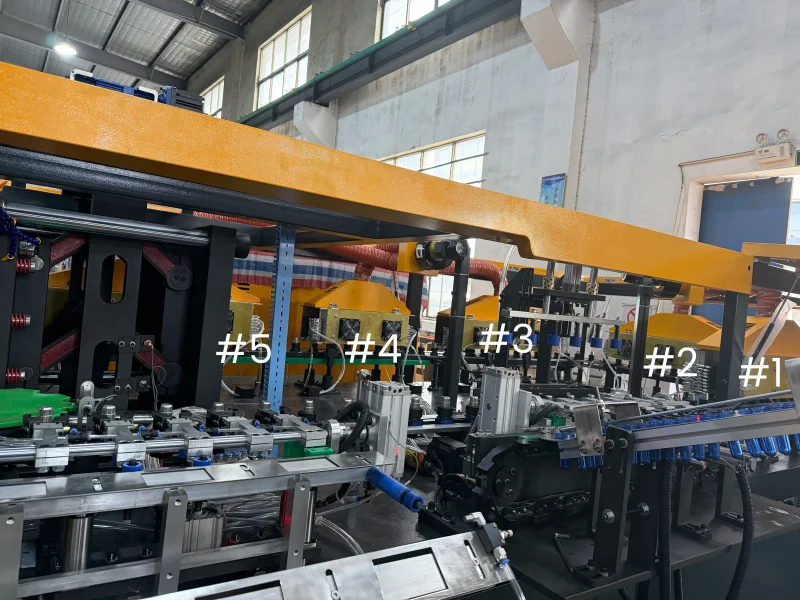
a traditional rotary blow molding machine with 6 cavities
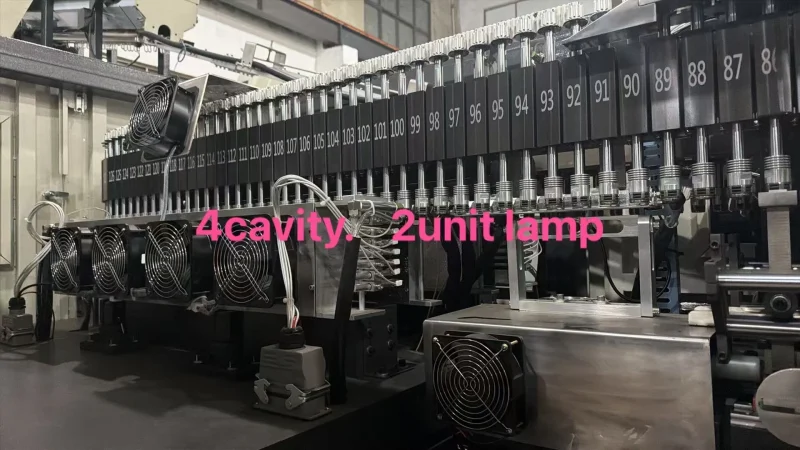
high-speed linear blow molding machine with 4 cavities
Notably, the energy-saving advantage of linear high-speed machines does not come at the cost of production efficiency. By optimizing the conveying and molding processes, they achieve stable high-speed production (some models can produce thousands of bottles per hour) to meet medium and large-scale production needs. Due to structural limitations, rotary machines not only consume more energy but also have poorer stability at high speeds, leading to a wider energy consumption gap and significant cost differences in long-term operation.
