
As global demand for faster, more reliable bottling solutions continues to rise, manufacturers across the beverage, pharmaceutical, and personal care industries are prioritizing automation to enhance productivity and ensure consistent quality. In response, advanced automatic blowing machines have become essential in modern production lines, offering precision, energy efficiency, and scalability. This 2026 audit list highlights the top nine manufacturers of automatic blowing machines for plastic bottles, recognized for innovation, technical performance, and market impact in the evolving plastic machinery landscape.
Os 9 principais fabricantes de máquinas de sopro automático para garrafas de plástico (lista de auditoria de 2026)
(Classificado por Capacidade de Produção e Pontuação de Confiança)

Professional Sourcing Guide: Automatic Blowing Machine For Plastic Bottles
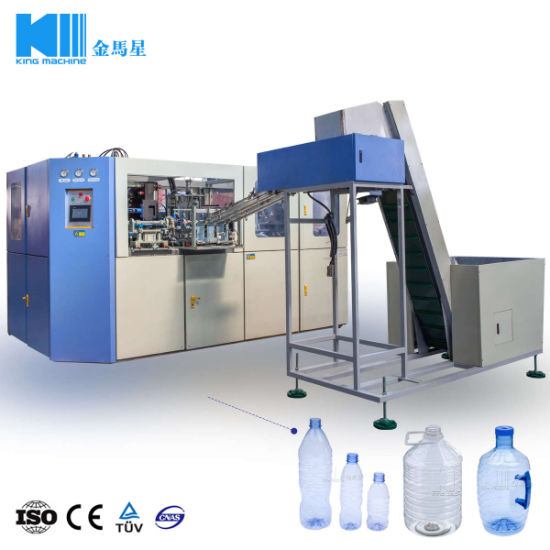
2026 Global Market Trends for Automatic Blowing Machines for Plastic Bottles
Produção a alta velocidade
The demand for high-speed production in automatic blowing machines for plastic bottles is projected to accelerate through 2026, driven by rising global consumption of bottled beverages, pharmaceuticals, and personal care products. Manufacturers are increasingly investing in machines capable of producing over 20,000 bottles per hour to meet just-in-time supply chain requirements and reduce per-unit manufacturing costs.
Key developments include the integration of multi-cavity molds and rapid cycle technologies that significantly shorten preform heating and cooling times. Leading equipment suppliers are introducing rotary-wheel and linear stretch blow molding systems with enhanced synchronization between preform feeding, heating, and blowing stages. These innovations improve throughput without compromising bottle quality, especially in the PET (polyethylene terephthalate) sector.
Moreover, the expansion of emerging markets in Asia-Pacific and Africa is fueling demand for scalable, high-output solutions. Beverage giants such as Coca-Cola and PepsiCo are prioritizing regional production hubs equipped with high-speed machines to localize supply and reduce logistics costs. As a result, the global market is shifting toward modular designs that allow quick changeovers and support diverse bottle formats at high velocities.
Energy Saving Technologies (Servo Motor)
Energy efficiency has become a critical differentiator in the automatic blowing machine market, with servo motor technology leading the charge in reducing power consumption. By 2026, over 75% of new machines are expected to feature full-servo or hybrid servo-hydraulic drives, replacing traditional hydraulic systems that are less efficient and more maintenance-intensive.
Servo motors offer precise control over motion and pressure, enabling energy savings of up to 40–50% during operation. These motors consume power only when in motion, unlike hydraulic systems that run continuously. Additionally, servo-driven machines generate less heat, reducing the need for cooling and extending component lifespan.
Regulatory pressures and corporate sustainability goals are accelerating adoption. The European Union’s Green Deal and similar environmental mandates in North America and Japan are pushing manufacturers to lower their carbon footprint. Machine builders such as Sidel, Krones, and Bekum are now offering servo-based platforms as standard, highlighting energy performance in their marketing. Innovations like regenerative braking and smart energy recovery systems are being integrated to further optimize efficiency.
The total cost of ownership (TCO) advantage of servo-driven machines—despite higher initial investment—is driving widespread acceptance, particularly in energy-cost-sensitive regions like Southeast Asia and Latin America.
Nível de automatização
Automation in automatic blowing machines is advancing rapidly, with 2026 set to mark a transition toward fully integrated, Industry 4.0-ready production lines. Modern systems now feature end-to-end automation, including automated preform loading, in-line quality inspection, robotic bottle handling, and real-time performance monitoring via IoT platforms.
Key trends include the integration of Artificial Intelligence (AI) and machine learning algorithms for predictive maintenance and process optimization. These systems analyze data from sensors embedded in the blowing machine to detect anomalies, adjust parameters dynamically, and minimize downtime. For example, AI can predict mold wear or heating element failure before it impacts production.
Cloud-based monitoring allows remote diagnostics and support, enabling OEMs to provide proactive service. Digital twins—virtual replicas of physical machines—are being used for simulation, training, and performance benchmarking, reducing commissioning time and improving operational efficiency.
Higher automation levels also support labor reduction and improved safety, particularly in high-wage economies. Fully automated lines can operate with minimal human intervention, aligning with trends in smart factories. The integration with upstream (injection molding) and downstream (filling, labeling) equipment via standardized communication protocols (e.g., OPC UA) ensures seamless data flow across the production ecosystem.
As cybersecurity and data privacy concerns are addressed, the adoption of cloud-connected, automated blowing machines is expected to grow across both developed and developing markets by 2026.
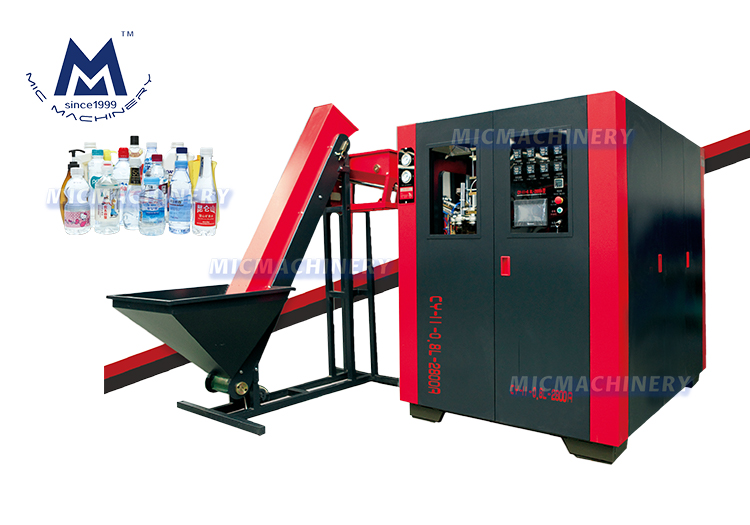
Quality Verification Checklist for Automatic Blowing Machine Manufacturers
When evaluating manufacturers of automatic blowing machines for plastic bottles, it’s essential to assess key quality indicators to ensure reliability, efficiency, and long-term performance. Focus on the following critical check points:
Material do molde (Alumínio vs. Aço)
- Verificar a especificação do material: Confirm whether molds are constructed from aluminum, steel, or a combination. Steel molds (e.g., P20, 420 stainless) offer superior durability and longevity, especially for high-volume production.
- Avaliar a adequação da aplicação: Aluminum molds are lighter and offer faster cooling, suitable for prototypes or low-volume runs, but may wear faster. Ensure the material aligns with your production needs.
- Verificar o acabamento e a dureza da superfície: Insist on documented hardness ratings (e.g., HRC for steel) and polished cavity finishes to ensure consistent bottle clarity and reduce defects.
- Solicitar certificações de materiais: Ask for mill test certificates or material compliance reports to verify authenticity and quality.
Marca de PLC (Siemens vs. Mitsubishi)
- Confirmar o modelo e a origem do PLC: Ensure the machine uses genuine Siemens or Mitsubishi PLCs—industry leaders known for reliability, precision, and robust support.
- Evaluate Control Interface: Test the HMI (Human-Machine Interface) for user-friendliness, real-time diagnostics, and data logging capabilities.
- Check Software and Programming: Verify if the PLC is pre-programmed with optimized blowing cycles and supports easy recipe changes for different bottle formats.
- Demand Warranty and Support Documentation: Ensure the manufacturer provides technical support and firmware updates for the specified PLC brand.
Eficiência do tempo de ciclo
- Solicitar dados de desempenho verificados: Ask for documented cycle time metrics (seconds per bottle) under standard operating conditions for specific bottle sizes (e.g., 500ml PET).
- Conduct On-Site or Video Demonstrations: Observe the machine running at full capacity to validate claimed cycle times and measure actual output consistency.
- Avaliar o consumo de energia e de ar: Efficient machines maintain fast cycle times while minimizing compressed air and power usage. Request energy efficiency reports.
- Evaluate Stability Over Time: Inquire about mean time between failures (MTBF) and how cycle time consistency is maintained during prolonged operation.
Disponibilidade de peças sobressalentes
- Review Spare Parts List: Request a comprehensive list of commonly replaced components (e.g., seals, valves, heating elements, stretch rods).
- Check Local and Global Supply Chain: Confirm whether the manufacturer maintains regional warehouses or partners that can deliver critical spare parts within 48–72 hours.
- Evaluate Part Standardization: Machines using standardized components (e.g., pneumatic fittings, sensors from known brands) reduce downtime and sourcing complexity.
- Confirm Long-Term Support: Verify the manufacturer’s policy on parts availability—ideally, a commitment to support machines for at least 10 years post-purchase.
By rigorously assessing these four check points—Mold Material, PLC Brand, Cycle Time Efficiency, and Spare Parts Availability—you can confidently verify the quality and reliability of an automatic blowing machine manufacturer for plastic bottle production.
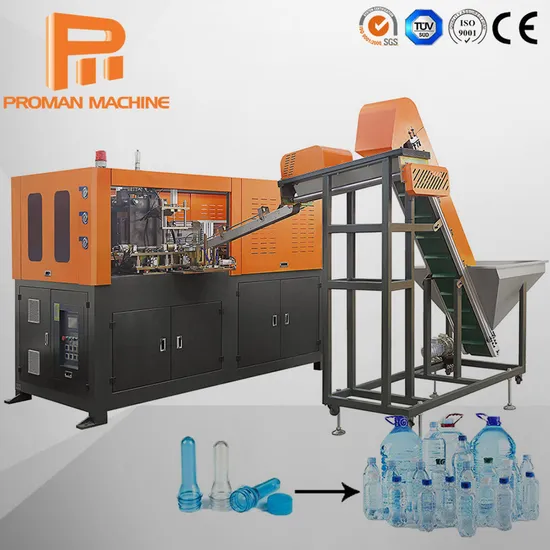
Configuration Guide for Automatic Blowing Machine For Plastic Bottles
Seleção do número da cavidade
The cavity number determines the machine’s output capacity and should be selected based on production requirements. Common configurations include 1, 2, 4, 6, 8, or 12 cavities. A higher cavity count increases output but also requires more floor space, higher energy consumption, and greater auxiliary support. Consider the following when selecting:
- Production Volume: Match cavity count to daily or hourly output targets.
- Bottle Size and Cycle Time: Larger bottles or complex designs may require longer cycle times, favoring fewer cavities with higher efficiency.
- Budget and Space: Higher cavity machines are more expensive and require larger facilities.
- Flexibility: Lower cavity machines (e.g., 1–4) offer better flexibility for frequent product changeovers.
Gama de volumes de garrafas
Automatic blowing machines are designed to handle a specific range of bottle volumes, typically from 100 ml to 5,000 ml or more. Confirm the machine’s compatibility with your target bottle sizes:
- Minimum and Maximum Volume: Ensure the machine’s mold base and stretch rod system can accommodate both ends of the volume range.
- Neck Finish Compatibility: Verify that the machine supports the required neck specifications (e.g., 28mm, 38mm PCO, etc.) across all intended bottle sizes.
- Wall Thickness Control: For wide volume ranges, ensure the machine offers precise stretch rod positioning and pressure control to maintain consistent bottle quality.
Compatibilidade de pré-formas
The blowing machine must be compatible with the preform specifications used in production:
- Dimensões da pré-forma: Match preform length, outer diameter, and neck finish to the machine’s clamp unit and mold design.
- Gama de peso da pré-forma: Confirm the machine can handle the range of preform weights required for different bottle volumes (e.g., 10g to 60g).
- Fornecedor de pré-formas: Ensure consistency in preform quality and material (typically PET) to avoid blowing defects. Some machines support multi-layer or barrier preforms—confirm capability if needed.
- Compatibilidade do sistema de aquecimento: The infrared oven must uniformly heat the preform based on its wall thickness and material properties.
Equipamento auxiliar (Compressor/Chiller)
Proper auxiliary equipment is essential for stable and efficient operation of the blowing machine:
Compressor de ar
- Capacity and Pressure: The compressor must deliver clean, dry air at 25–40 bar (360–580 psi), depending on the machine and bottle design. Flow rate should match the machine’s peak demand (e.g., 2–4 m³/min per cavity).
- Qualidade do ar: Use oil-free compressors or high-efficiency filters to prevent contamination. Moisture and oil can damage valves and molds.
- Armazenamento: Include an air receiver tank (minimum 1,000 liters for a 6-cavity machine) to buffer pressure fluctuations.
Refrigerador
- Capacidade de arrefecimento: Required to cool molds and maintain consistent cycle times. Typical capacity ranges from 3 to 15 RT (refrigeration tons), depending on cavity count and output.
- Controlo da temperatura: Maintain mold temperature between 10–15°C (50–59°F) for optimal PET crystallization and cycle efficiency.
- Qualidade da água: Use treated, low-conductivity water to prevent scaling and corrosion in cooling channels. Include filters and automatic blowdown systems.
- Caudal: Ensure sufficient coolant flow (e.g., 50–100 L/min) with minimal pressure drop across the system.
Ensure all auxiliary systems are properly sized, integrated, and maintained to support continuous, high-quality bottle production.
In conclusion, sourcing an automatic blowing machine for plastic bottles from China presents a compelling opportunity to achieve cost-efficiency without compromising on quality or performance. Chinese manufacturers offer advanced technology, competitive pricing, and scalable production capacity, making them a strategic choice for global buyers. However, ensuring reliability and minimizing downtime is critical, which is why incorporating a comprehensive Factory Acceptance Test (FAT) into the procurement process is essential. The FAT allows for on-site verification of machine performance, operational stability, and adherence to technical specifications before shipment, significantly reducing the risk of post-delivery issues.
Equally important is the availability of robust spare parts support. Given the operational demands of continuous production, having timely access to genuine spare parts and responsive technical assistance is vital for minimizing downtime and extending the machine’s service life. Therefore, partnering with a supplier that offers a clear spare parts supply agreement, documented inventory availability, and responsive after-sales service will ensure long-term operational efficiency.
By prioritizing suppliers that guarantee a rigorous FAT process and reliable spare parts support, buyers can confidently invest in a high-performance automatic blowing machine from China, laying a strong foundation for scalable, uninterrupted production and long-term success.






