
As global demand for sustainable and high-speed water bottling solutions continues to rise, manufacturers are prioritizing automation, energy efficiency, and end-to-end integration in their production lines. With the bottled water market projected to expand significantly by 2026, sourcing reliable partners who deliver cutting-edge technology and proven scalability has never been more critical. This guide highlights the top eight water bottle production process manufacturers—vetted for innovation, reliability, and automation capabilities—to support strategic procurement decisions in an increasingly competitive landscape.
Lista de los 8 principales fabricantes del proceso de producción de botellas de agua (auditoría de 2026)
(Clasificación por capacidad de producción y puntuación de confianza)

Professional Sourcing Guide: Water Bottle Production Process

H2: 2026 Global Market Trends in Water Bottle Production Process: High-Speed Production, Energy-Saving Technologies, and Automation
As the global water bottle market continues to expand—driven by rising consumer demand for bottled water, health awareness, and on-the-go lifestyles—the production landscape is undergoing a transformative shift. By 2026, water bottle manufacturing is expected to be dominated by three key technological and operational trends: producción a alta velocidad, energy-saving technologies (particularly servo motor integration), y niveles avanzados de automatización. These developments are not only enhancing efficiency and scalability but are also aligning with growing sustainability mandates and cost-optimization strategies.
Producción a alta velocidad: Satisfacer la creciente demanda
The demand for water bottles—especially PET (polyethylene terephthalate) bottles—is projected to grow at a compound annual growth rate (CAGR) of 5.2% through 2026. To meet this demand, manufacturers are investing heavily in high-speed production lines capable of producing over 60,000 bottles per hour per machine.
- Blow molding advancements: Modern stretch blow molding machines now integrate rotary reheat systems and rapid cooling techniques, reducing cycle times and increasing throughput. By 2026, high-speed rotary systems are expected to dominate over linear systems in large-scale facilities.
- Integration with bottling lines: High-speed bottle production is increasingly synchronized with filling and capping systems. This seamless integration minimizes downtime and supports continuous, high-volume output for multinational beverage companies.
- Regional adoption: Asia-Pacific, particularly China and India, will lead in adopting high-speed systems due to rapid urbanization and rising consumption. North America and Western Europe are focusing on retrofits and upgrades to existing lines for speed optimization.
Energy-Saving Technologies: Servo Motors as a Game Changer
Energy consumption accounts for a significant portion of water bottle production costs. In response, manufacturers are adopting servo motor-driven systems to reduce energy use and improve precision.
- Servo motor advantages: Unlike traditional hydraulic or pneumatic systems, servo motors offer precise control over motion, reducing energy waste by up to 40%. They are especially effective in stretch blow molding machines, where they control preform feeding, stretching rods, and mold closing mechanisms.
- Energy recovery systems: By 2026, over 60% of new production lines are expected to feature servo-electric drives combined with regenerative braking systems, which capture and reuse energy during deceleration phases.
- Sustainability compliance: With tightening regulations on carbon emissions (e.g., EU Green Deal, U.S. EPA guidelines), energy-efficient technologies like servo motors help producers meet environmental standards while cutting operational costs. This is accelerating their adoption in both emerging and developed markets.
Automation Level: From Semi-Automated to Fully Integrated Smart Factories
Automation is rapidly evolving from isolated robotic arms to fully integrated, data-driven production ecosystems.
- End-to-end automation: By 2026, leading manufacturers will operate Industry 4.0-ready facilities featuring automated material handling, robotic palletizing, real-time quality inspection (via AI-powered vision systems), and predictive maintenance.
- Digital twins and IoT integration: Digital twin technology allows manufacturers to simulate production lines for optimization before physical implementation. Combined with IoT sensors, this enables real-time monitoring of machine performance, energy use, and output quality.
- Labor cost and consistency benefits: Fully automated systems reduce reliance on manual labor, minimize human error, and ensure consistent product quality—critical for global brands with strict quality control standards.
- Adoption trends: While large corporations (e.g., Nestlé, Coca-Cola) lead in full automation, small and medium enterprises (SMEs) are increasingly adopting modular automation solutions that offer scalability and lower upfront investment.
Conclusión
By 2026, the global water bottle production process will be defined by high-speed capabilities, energy-efficient servo motor technologies, y advanced automation systems. These trends are converging to create smarter, greener, and more responsive manufacturing environments. Companies that invest early in integrated, sustainable, and automated production lines will gain a significant competitive advantage in terms of cost, scalability, and environmental compliance. As consumer and regulatory pressures intensify, innovation in production technology will remain a cornerstone of success in the water bottle industry.
Quality Verification for Water Bottle Production Process Manufacturer
When evaluating a water bottle production process manufacturer, focusing on key technical and operational aspects ensures consistent product quality and production reliability. Below are critical check points to verify:
Material del molde (aluminio frente a acero)
- Moldes de acero: Preferred for high-volume production due to superior durability, wear resistance, and longer service life. Verify the use of hardened tool steel (e.g., P20, H13, or 420 stainless) for molds to ensure dimensional stability and resistance to corrosion.
- Moldes de aluminio: Suitable for prototyping or low-volume runs due to faster cooling and lower cost, but less durable. Confirm the manufacturer justifies aluminum use based on production volume and lifecycle expectations.
- Método de verificación: Request mold material certification or mill test reports (MTRs). Inspect mold specifications in technical documentation and conduct on-site verification during factory audit.
Marca de PLC (Siemens frente a Mitsubishi)
- PLC Siemens: Known for robust performance, global support, and integration with Industry 4.0 systems. Widely used in automated blow molding or injection systems.
- PLC Mitsubishi: Offer reliable control, strong I/O capabilities, and are common in Asian-manufactured machinery. Evaluate based on system compatibility and spare parts accessibility.
- Método de verificación: Review control panel documentation and photos to confirm PLC brand and model. Ensure the manufacturer uses original, non-counterfeit components. Validate firmware versions and availability of programming support.
Eficacia de la duración del ciclo
- Benchmark Standards: For standard PET water bottles (500ml–1L), typical blow molding cycle times range from 8–15 seconds per cavity, depending on machine configuration and bottle design.
- Efficiency Metrics: Assess overall equipment effectiveness (OEE), including uptime, speed, and reject rate. Ask for production logs or trial run data showing actual cycle times under full load.
- Método de verificación: Conduct time-motion studies during production trials. Compare quoted cycle times with industry benchmarks and verify consistency across multiple production runs.
Disponibilidad de piezas de recambio
- Componentes críticos: Confirm availability of common wear items such as seals, heaters, stretch rods, die heads, and calibration sleeves.
- Lead Time & Inventory: Evaluate the manufacturer’s spare parts inventory and supply chain. Prefer suppliers with local warehouses or partnerships with global distributors.
- Documentation: Request a complete spare parts list (SPL) with part numbers, OEM references, and recommended stock levels.
- Método de verificación: Ask for proof of existing inventory or supply agreements. Check online support portals or contact distributors to validate part accessibility and typical lead times.
By systematically verifying these four key areas—mold material, PLC brand, cycle time efficiency, and spare parts availability—you can ensure the manufacturer delivers a reliable, high-quality water bottle production process.
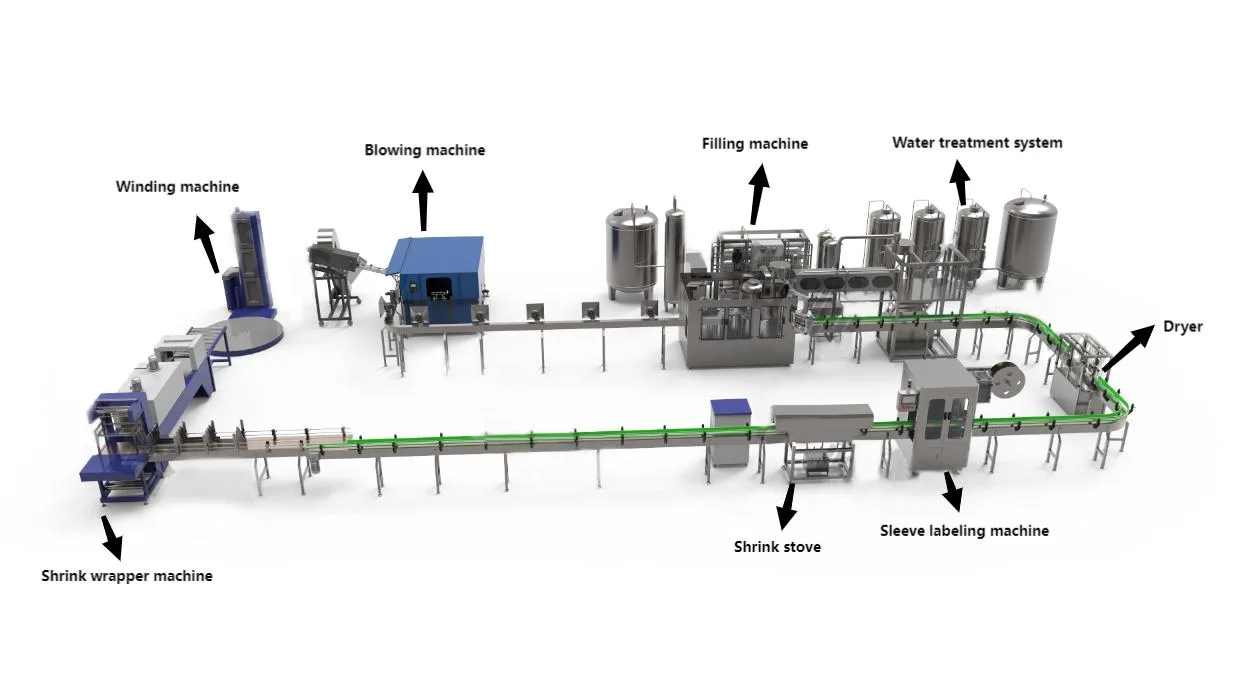
Water Bottle Production Process Configuration Guide
Selección del número de cavidades
The cavity number refers to the number of molds in the injection or blow molding machine and directly impacts production capacity and efficiency.
- Low-Volume Production (1–8 cavities): Suitable for small-scale operations, prototyping, or facilities producing a variety of bottle sizes. Offers flexibility and lower initial investment but reduced output.
- Medium-Volume Production (12–24 cavities): Ideal for regional distribution or medium-sized beverage brands. Balances cost and output, supporting efficient runs of standard bottle sizes.
- High-Volume Production (32–72+ cavities): Designed for large-scale bottling plants (e.g., major beverage companies). Maximizes output but requires high capital investment and consistent demand.
- Criterios de selección: Consider annual production targets, changeover frequency, factory floor space, and desired output speed (bottles per hour). Higher cavities improve cost per unit but reduce flexibility.
Volumen de la botella
The production system must be configured to accommodate the target bottle volumes, typically ranging from small single-serve to large multi-liter containers.
- Gama estándar: 300 mL to 2,000 mL covers most beverage applications (e.g., water, soft drinks).
- Tamaños especiales: Systems can be adapted for volumes as small as 200 mL (mini bottles) or as large as 5,000 mL (jugs or refill containers).
- Tooling Requirements: Each volume requires specific mold sets. Multi-cavity machines can be designed for single volume or multi-volume capability (e.g., 500 mL and 1,000 mL).
- Production Planning: Ensure the selected machine supports the full range of intended products to avoid frequent changeovers and downtime.
Compatibilidad de preformas
Preform compatibility ensures that the raw PET (polyethylene terephthalate) preforms are suitable for the blow molding process and end-product quality.
- Preform Type: Standard neck finish (e.g., PCO 1881, 26 mm, 38 mm) must match the chosen bottle cap and filling line.
- Weight & Wall Thickness: Preform weight varies with bottle volume and design (e.g., 18 g for 500 mL water bottle). Confirm compatibility with the stretch blow molder’s heating and stretching mechanism.
- Material Grade: Use food-grade, amorphous PET resin with proper intrinsic viscosity (IV ~0.78–0.84 dl/g) for strength and clarity. Recycled PET (rPET) compatibility should be verified with machine specifications.
- Supplier Integration: Ensure preform dimensions (length, diameter, neck finish) match the mold and handling system to prevent jamming or defective bottles.
Equipos auxiliares (compresor y enfriadora)
Auxiliary systems are critical for stable and efficient operation of the blow molding machine.
Compresor:
- Propósito: Provides clean, dry compressed air (typically 25–40 bar) for the stretch blow molding process (e.g., preform stretching and bottle blowing).
- Especificaciones: Use oil-free compressors to prevent contamination. Capacity should match peak air demand (e.g., 1.5–3.0 Nm³/min per 12 cavities).
- Tratamiento del aire: Include air dryers and filters to ensure dew point ≤ -20°C and eliminate moisture and particulates.
Enfriador:
- Propósito: Cools molds and machine hydraulics to maintain dimensional accuracy and cycle time.
- Capacidad de refrigeración: Typically 5–20 kW depending on cavity count and output rate. Water temperature should be maintained at 8–12°C.
- Calidad del agua: Use demineralized or softened water to prevent scaling in cooling channels. Closed-loop systems are recommended.
Integration & Sizing:
– Size compressors and chillers with a 20% safety margin above calculated requirements.
– Ensure centralized or dedicated units with proper piping to minimize pressure drops and thermal loss.
– Monitor performance with sensors and alarms for predictive maintenance.
Proper configuration of cavity count, volume range, preform compatibility, and auxiliary systems ensures efficient, reliable, and high-quality water bottle production.
In conclusion, sourcing water bottle production equipment from China offers significant advantages in terms of cost-efficiency, manufacturing scalability, and access to advanced automation technologies. However, to ensure long-term operational success and minimal downtime, it is essential to emphasize two critical aspects: the Factory Acceptance Test (FAT) and comprehensive spare parts support. Conducting a rigorous FAT before shipment allows buyers to verify the equipment’s functionality, performance, and compliance with technical specifications under real operating conditions, reducing the risk of post-installation issues. Equally important is establishing a reliable spare parts supply chain, ensuring timely availability of critical components to support maintenance and repair activities. By prioritizing a thorough FAT process and securing robust spare parts logistics—either through on-hand inventory or responsive supplier agreements—companies can maximize equipment uptime, maintain production continuity, and achieve a strong return on investment when sourcing from Chinese manufacturers.






