
As global demand for bottled water and liquid refreshments continues to rise, manufacturers are prioritizing high-efficiency, automated bottling solutions to meet production scales and quality standards. In this evolving landscape, 5-gallon bottle blowing machines have become critical assets—driving the need for reliable, innovative, and scalable equipment. This 2026 audit highlights the top six manufacturers leading the market with advanced automation, energy-efficient technology, and proven performance in large-capacity PET production. For sourcing professionals and plant operations leaders, this list serves as a strategic reference for investing in future-ready bottling infrastructure.
Los 6 principales fabricantes de máquinas de soplado de botellas de 5 galones (Lista de auditoría 2026)
(Clasificación por capacidad de producción y puntuación de confianza)

Professional Sourcing Guide: Bottle Blowing Machine 5 Gallon

2026 Global Market Trends for 5-Gallon Bottle Blowing Machines: Focus on High-Speed Production, Energy Saving Technologies, and Automation
Producción a alta velocidad
In 2026, the global demand for high-speed 5-gallon bottle blowing machines is projected to grow significantly, driven by increasing consumption of bottled water, home and office delivery (HOD) systems, and industrial liquid packaging. Manufacturers are prioritizing machinery capable of producing 1,500 to 3,000 bottles per hour, with leading-edge systems reaching up to 3,600 bottles per hour using rotary wheel designs.
Key advancements include the integration of multi-cavity molds, optimized preform feeding systems, and rapid cooling technologies that reduce cycle times. High-speed machines are increasingly modular, allowing scalability for mid-sized bottlers seeking to expand capacity without replacing entire systems. The Asia-Pacific region—especially China, India, and Southeast Asia—is leading adoption due to rising urbanization and demand for packaged drinking water, while North America and Europe are upgrading legacy lines to meet throughput demands efficiently.
Market players such as Sidel, Krones, and SIPA are launching next-generation models with intelligent pressure control and adaptive blow profiles, enhancing both speed and bottle consistency. By 2026, high-speed machines are expected to account for over 60% of new installations in the 5-gallon segment, particularly in markets with labor cost pressures and the need for just-in-time production.
Energy Saving Technologies: Rise of Servo Motors
Energy efficiency has become a core competitive differentiator in the 5-gallon bottle blowing machine market, with servo motor technology playing a pivotal role. By 2026, over 75% of new machines are projected to feature full-servo or hybrid servo-hydraulic drives, replacing traditional hydraulic systems that consume 30–40% more energy.
Servo motors offer precise control over stretching rod movement, clamp force, and blow head positioning, drastically reducing compressed air and electrical usage. Machines equipped with servo technology demonstrate up to 35% lower energy consumption and reduced oil dependency, aligning with global sustainability standards and ESG (Environmental, Social, Governance) goals.
Additionally, servo-driven systems generate less heat and noise, improving factory working conditions and lowering maintenance frequency. Manufacturers are combining servo actuators with regenerative braking systems and smart energy recovery during idle phases. In regions with high electricity costs—such as Western Europe and Japan—servo-based machines are becoming the default choice. Regulatory incentives, including tax rebates and carbon credits in countries like Germany and South Korea, are further accelerating adoption.
Automation Level and Smart Manufacturing Integration
By 2026, automation in 5-gallon bottle blowing machines will extend beyond robotic handling to include full Industry 4.0 connectivity. Advanced systems now feature integrated SCADA (Supervisory Control and Data Acquisition), IoT-enabled sensors, and AI-driven predictive maintenance. These technologies allow real-time monitoring of parameters such as preform temperature, air pressure, and mold wear, minimizing downtime and ensuring consistent bottle quality.
Fully automated lines include automatic mold change systems (AMC), robotic preform loaders, and inline leak testing and vision inspection systems. These reduce labor dependency and human error, crucial in markets facing labor shortages. In China and India, government initiatives promoting smart manufacturing are boosting investments in automated blowing lines.
Cloud-based platforms enable remote diagnostics and performance benchmarking across multiple facilities. Machine learning algorithms analyze production data to optimize blow pressure and cycle duration dynamically. OEMs are also offering digital twin technology, allowing operators to simulate production scenarios before implementation.
As a result, automation levels in the 5-gallon blowing machine market are expected to rise from an average of 60% in 2022 to over 80% by 2026. This shift is particularly evident in large-scale bottling plants serving multinational brands, where traceability, uptime, and operational efficiency are paramount.
Key Quality Verification Points for 5-Gallon Bottle Blowing Machine Manufacturers
When evaluating a manufacturer of 5-gallon bottle blowing machines, focusing on critical components and performance metrics ensures reliability, efficiency, and longevity. Below are the essential check points to assess machine quality:
Material del molde (aluminio frente a acero)
The mold material significantly impacts durability, thermal conductivity, and overall production cost. Verify the following:
- Moldes de acero: Preferred for high-volume production due to superior durability, resistance to wear, and longer lifespan. Ideal for continuous operation and environments with abrasive preforms.
- Moldes de aluminio: Offer faster heat dissipation and are lighter, beneficial for rapid cycle times and prototyping. However, they are less durable and more prone to damage under heavy use.
- Recomendación: Confirm that the manufacturer uses hardened tool steel (e.g., P20 or H13) for molds in commercial-scale operations. Request mold hardness ratings and surface treatment details (e.g., chrome plating) to assess longevity.
Marca de PLC (Siemens frente a Mitsubishi)
The Programmable Logic Controller (PLC) is the machine’s brain, governing automation, precision, and fault diagnostics. Assess:
- PLC Siemens: Known for robust performance, excellent integration with industrial networks, and global support. Commonly used in high-end machinery.
- PLC Mitsubishi: Offer strong reliability, user-friendly programming, and widespread use in packaging machinery. Also backed by extensive service networks.
- Pasos de verificación: Confirm the exact PLC model used (e.g., Siemens S7-1200, Mitsubishi FX or Q series). Evaluate the HMI interface for intuitiveness and language support. Ensure firmware is upgradable and that the manufacturer provides ladder logic documentation.
Eficacia de la duración del ciclo
Cycle time directly affects production output and operational cost. Key considerations:
- Estándar de referencia: A high-efficiency 5-gallon blowing machine should achieve 12–18 bottles per minute (720–1,080 bottles/hour), depending on configuration and preform design.
- Factors Influencing Cycle Time: Preform heating efficiency, stretch rod speed, mold cooling rate, and automation integration.
- Validation Method: Request a live demonstration or video of continuous operation. Measure actual cycle time over multiple runs and compare with manufacturer claims. Also, inquire about energy consumption per cycle.
Disponibilidad de piezas de recambio
Minimizing downtime requires prompt access to replacement components. Evaluate the manufacturer’s spare parts strategy:
- Inventario local: Confirm if the supplier maintains a local warehouse or partners with distributors in your region.
- Componentes críticos: Ensure availability of high-wear items such as sealing rings, stretch rods, heating lamps, O-rings, and nozzle valves.
- Plazos de entrega: Request average lead times for common and long-lead parts. A reliable manufacturer should offer a comprehensive spare parts list with pricing and expected delivery times.
- Documentación de apoyo: Verify that the machine comes with a detailed parts manual, exploded diagrams, and recommended maintenance schedules.
By thoroughly assessing these four key areas—material del molde, marca del PLC, eficiencia del tiempo de ciclo y disponibilidad de piezas de repuesto—you can confidently select a high-quality 5-gallon bottle blowing machine manufacturer that ensures productivity, durability, and minimal operational interruptions.
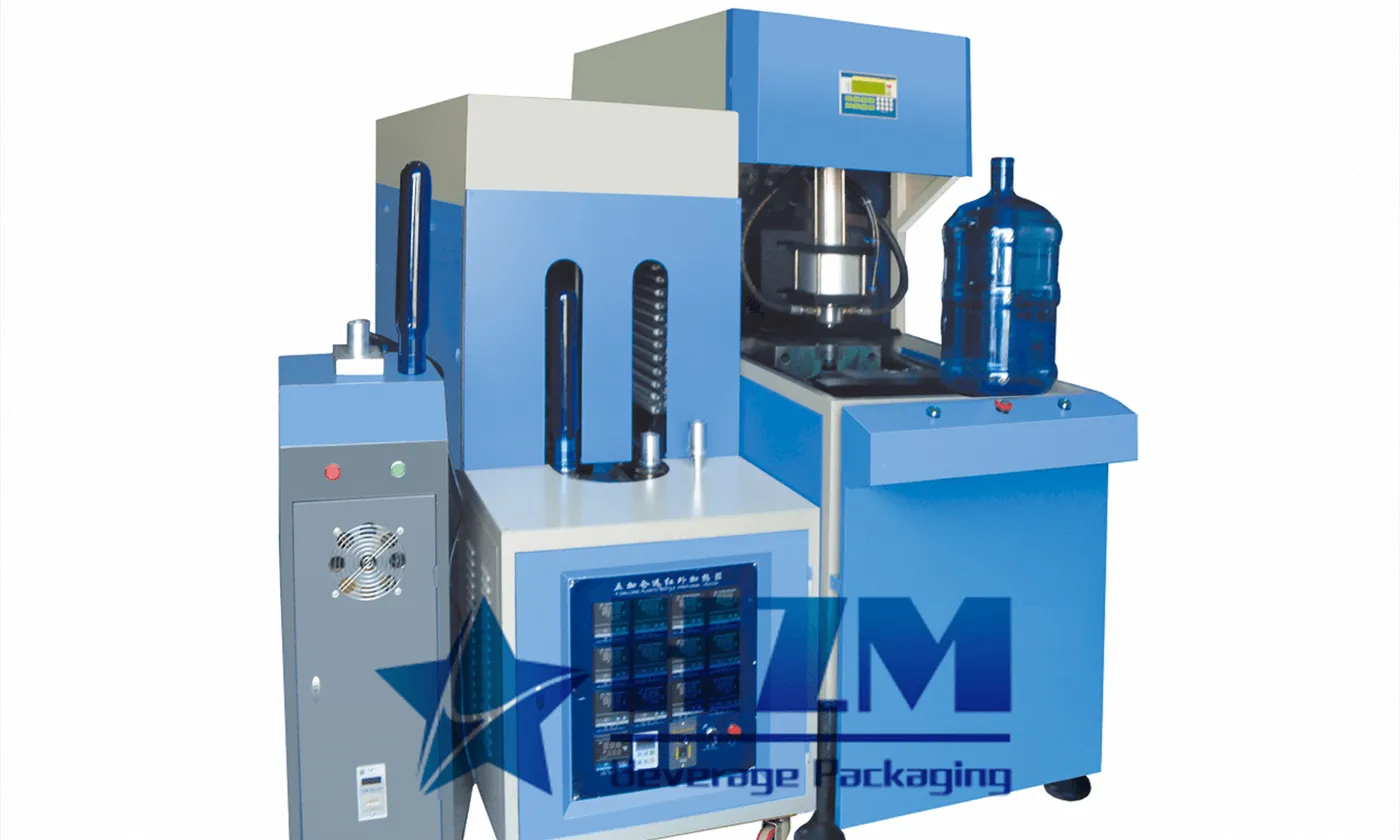
Configuration Guide for 5-Gallon Bottle Blowing Machine
Selección del número de cavidades
The cavity number refers to the number of bottles produced per cycle and is a critical factor in determining production capacity. For a 5-gallon bottle blowing machine, cavity options typically range from 1 to 4 cavities, depending on output requirements and available floor space.
- Cavidad simple (1 cavidad): Ideal for low-volume production, R&D, or custom bottle manufacturing. Offers flexibility and ease of operation but lower output (typically 400–600 bottles/hour).
- Double Cavity (2-Cavity): Suitable for medium-scale operations. Balances cost and productivity, producing approximately 800–1,200 bottles/hour.
- Triple/Quad Cavity (3–4 Cavity): Designed for high-volume production facilities. Output ranges from 1,200 to 2,400 bottles/hour. Requires higher investment and larger auxiliary systems.
Selection Tip: Match cavity number with your desired output, mold availability, and factory layout. Consider future scalability when selecting.
Volumen de la botella
While optimized for 5-gallon (18.9L) bottles, most modern stretch blow molding machines support a limited range of bottle sizes through mold changes and parameter adjustments.
- Standard Volume: 18.9 liters (5 US gallons) is the primary target.
- Adjustable Range: Some machines can accommodate bottles from 15L to 20L by changing molds and adjusting blow parameters.
- Limitations: Significant deviations from 5-gallon dimensions may require different preform sizes or machine configurations.
Nota: Always verify machine specifications with the manufacturer to confirm compatibility with non-standard volumes.
Compatibilidad de preformas
Proper preform selection is essential for consistent bottle quality and machine performance.
- Preform Size: Standard 5-gallon preforms typically have a weight range of 58–65 grams and a neck finish of 63mm (PCO 1881 or 63mm ID).
- Material: PET (Polyethylene Terephthalate) is standard. Ensure preforms are dried properly (moisture < 50 ppm) before processing.
- Compatibility: Confirm that the machine’s preform loader and heating oven are designed for the specific preform dimensions (length, diameter, neck design).
- Heating Zones: Machines should have adjustable infrared heating zones (typically 8–12) to uniformly heat preforms based on wall thickness and design.
Buenas prácticas: Use high-quality, consistent preforms from certified suppliers to minimize defects and maximize output.
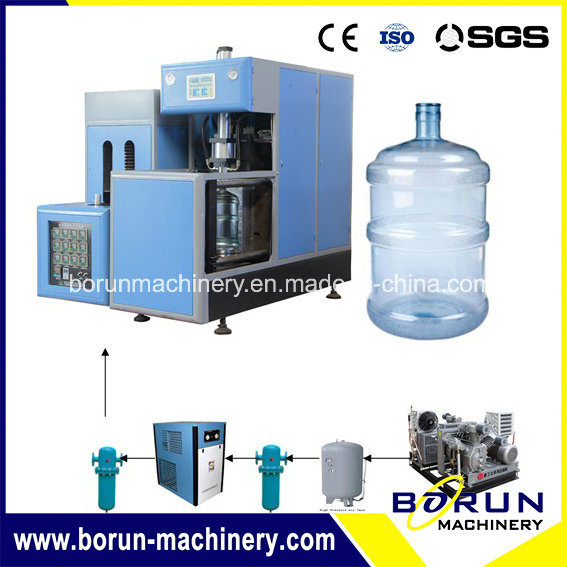
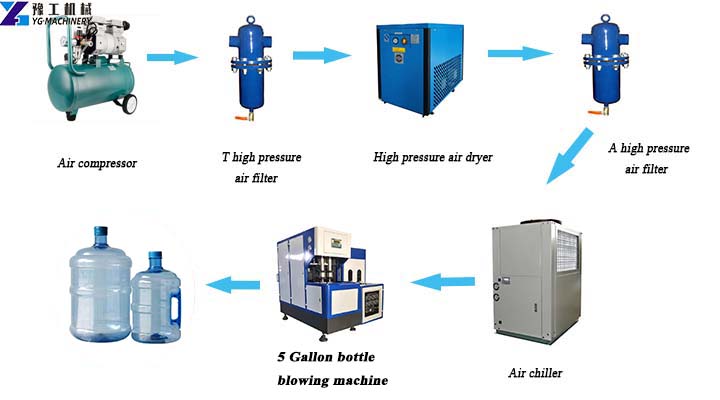
Equipo auxiliar (compresor/refrigerador)
Reliable auxiliary systems are crucial for stable operation and high-quality bottle production.
Compresor de aire
- Propósito: Supplies high-pressure air (25–40 bar) for the bottle blowing process.
- Capacity Requirement: Typically 1.5–3.0 m³/min per cavity, depending on cycle time and pressure.
- Calidad del aire: Must include air dryers and filters to ensure oil-free, moisture-free air (Class 1.4.1 per ISO 8573-1).
- Recomendación: Use a screw-type compressor with a refrigerated or desiccant dryer for continuous operation.
Chiller / Cooling System
- Propósito: Cools molds and machine hydraulics to maintain dimensional stability and cycle consistency.
- Capacidad de refrigeración: 3–8 kW per cavity, depending on ambient conditions and production speed.
- Calidad del agua: Use treated, low-conductivity water to prevent scaling in cooling channels.
- Control de temperatura: Maintain mold temperature between 10–15°C for optimal PET crystallization and cycle time.
Consejo de integración: Ensure auxiliary equipment is properly sized and synchronized with the blowing machine for seamless operation and energy efficiency.
In conclusion, sourcing a 5-gallon bottle blowing machine from China offers a cost-effective and technologically advanced solution for scaling up production efficiently. However, to ensure long-term reliability and operational continuity, it is imperative to prioritize suppliers who conduct a comprehensive Factory Acceptance Test (FAT) before shipment. The FAT serves as a critical validation step, confirming that the machine meets agreed-upon specifications, performs reliably under real operating conditions, and is free from manufacturing defects. A documented and witnessed FAT not only mitigates risks but also provides assurance of machine readiness for installation and commissioning.
Equally important is the availability of robust spare parts support. Given the continuous nature of bottle production, any downtime can significantly impact output and profitability. Therefore, partnering with a supplier that offers prompt access to genuine spare parts, maintains an adequate inventory, and provides technical documentation ensures minimal disruption and extends the machine’s service life. In selecting a Chinese manufacturer, due diligence in verifying their commitment to FAT procedures and after-sales spare parts support is essential to achieving a successful and sustainable investment in your bottling operations.






