
As global demand for sustainable, high-volume packaging surges, the blow molding industry is witnessing accelerated adoption of automated, energy-efficient bottling solutions. From beverage producers to pharmaceutical leaders, manufacturers are prioritizing precision, speed, and scalability in their production lines. In this evolving landscape, selecting the right blow molding machine supplier is critical to maintaining competitive advantage. This 2026 audit highlights the top 10 bottle blow molding machine manufacturers excelling in innovation, reliability, and integrated automation—driving efficiency across the modern bottling supply chain.
Top 10 Blow Molding Machine Bottle Manufacturers (2026 Audit List)
(Clasificación por capacidad de producción y puntuación de confianza)

Professional Sourcing Guide: Blow Molding Machine Bottle
2026 Global Market Trends for Blow Molding Machine Bottle: High-Speed, Energy Efficiency, and Automation
The global blow molding machine bottle market is poised for significant transformation by 2026, driven by escalating demands for productivity, sustainability, and operational efficiency. Key technological advancements in High-Speed Production, Energy Saving Technologies (particularly Servo Motors), and Automation Level are converging to reshape the industry landscape. Here’s an analysis of these critical trends:
High-Speed Production: The Unrelenting Pursuit of Output
- Dominant Driver: The primary demand driver remains maximizing output per machine hour to meet growing global consumption, reduce unit costs, and improve return on investment (ROI). This is especially critical for high-volume applications like PET water/soda bottles and HDPE containers.
- Trend Acceleration: Machine manufacturers are aggressively pushing speed limits. By 2026, expect:
- Higher Cavity Counts: Machines with 16, 24, 32, and even 48+ cavities will become more standard for PET, particularly in large-volume facilities, to achieve outputs exceeding 50,000 bottles per hour.
- Ciclos más rápidos: Advancements in parison control, preform handling, mold cooling (integrated systems), and ejection mechanisms will enable cycle times consistently below 4-5 seconds for standard bottles, with sub-3-second cycles feasible for optimized designs on high-speed lines.
- Material & Process Optimization: High-speed production will be intrinsically linked to optimized preform design, precise temperature control, and advanced process monitoring (AI/ML) to maintain quality at speed, reducing scrap rates.
- Impact: High-speed machines will dominate new capacity additions, particularly in emerging markets and for major beverage brands. However, this trend favors large-scale producers due to the significant capital investment required.
Energy Saving Technologies: Servo Motors as the Cornerstone
- Sustainability Imperative: Rising energy costs, corporate ESG (Environmental, Social, Governance) commitments, and regulatory pressure are making energy efficiency a non-negotiable requirement. Servo motor technology is the primary enabler.
- Servo Motor Dominance: By 2026, servo-driven blow molding machines will represent the vast majority of new installations, particularly for PET and increasingly for extrusion blow molding (EBM). Key benefits driving adoption:
- Significant Energy Reduction (30-50%+): Servo motors only consume power when moving, unlike traditional hydraulic pumps running continuously. This is the single largest energy-saving technology.
- Precisión y repetibilidad: Enable finer control over clamp force, stretch rod speed/position, and blow needle timing, improving bottle quality and consistency.
- Reduced Heat Generation & Noise: Lower operating temperatures extend component life and improve the factory environment.
- Lower Maintenance: Elimination of hydraulic oil, filters, pumps, and associated plumbing drastically reduces maintenance needs and costs.
- Más allá de los servos: While servos are central, the trend extends to holistic energy optimization:
- Integrated Heat Recovery: Capturing waste heat from compressors and dryers for preform heating or facility use.
- Advanced Process Control: AI-driven systems optimizing energy use based on production rate, ambient conditions, and bottle specs.
- Efficient Compressors & Dryers: Adoption of variable-speed drive (VSD) compressors and high-efficiency desiccant dryers.
- Impact: Energy efficiency, led by servo technology, will be a key differentiator and a major factor in purchasing decisions. Machines with demonstrable low energy consumption per bottle will command a premium and enhance brand sustainability credentials.
Automation Level: Towards Smart, Integrated Factories
- Beyond Basic Handling: Automation is evolving from simple robotic take-out and conveyors to fully integrated, data-driven systems. The goal is 24/7 unattended operation and seamless integration into Industry 4.0 frameworks.
- Key Trends for 2026:
- End-to-End Integration: Seamless connection between blow molder, upstream (preform drying/handling, injection molder), and downstream (leak testing, labeling, packing, palletizing) via standardized communication protocols (OPC UA).
- Robótica avanzada: Wider use of collaborative robots (cobots) for tasks like quality inspection, changeover assistance, and material handling in smaller cells. Vision-guided robots for precise handling.
- Mantenimiento predictivo: Integration of vibration, temperature, and pressure sensors with AI/ML platforms to predict component failures (e.g., valves, seals, motors) before they cause downtime, moving from reactive to predictive maintenance.
- Gemelos digitales y optimización de procesos: Creation of digital replicas of machines and processes to simulate, optimize settings, train operators, and troubleshoot issues virtually.
- Supervisión y asistencia remotas: Cloud-based platforms enabling OEMs and plant managers to monitor machine performance, diagnose issues, and provide support remotely, minimizing downtime.
- Impact: High levels of automation will become standard for new large-scale lines and increasingly accessible for mid-sized operations. It reduces labor costs, improves OEE (Overall Equipment Efficiency), enhances traceability, and provides critical data for continuous improvement. The “lights-out factory” concept will be more achievable.
Conclusión:
By 2026, the global blow molding machine bottle market will be defined by the synergy of High-Speed, Energy-Efficient (Servo-Driven), and Highly Automated systems. Success will belong to manufacturers and converters who embrace this integrated approach:
- High-Speed machines will be the baseline for competitiveness in high-volume segments.
- Servo Motor Technology will be the essential foundation for energy savings, precision, and reduced operating costs.
- Advanced Automation will be critical for maximizing uptime, ensuring quality, reducing labor dependency, and enabling data-driven decision-making within smart factories.
The convergence of these trends will drive significant productivity gains, lower environmental impact, and create a more resilient and efficient global supply chain for plastic bottles. Investment in machines incorporating all three elements will be paramount for long-term success.
Quality Verification Checklist for Blow Molding Machine Bottle Manufacturers
When evaluating a blow molding machine bottle manufacturer, assessing key technical and operational aspects ensures reliability, efficiency, and long-term performance. Below are critical check points to verify quality:
Material del molde (aluminio frente a acero)
- Inspeccionar las especificaciones del material: Confirm whether molds are made from aluminum or steel. Steel molds (e.g., P20, H13) offer superior durability and longevity for high-volume production, while aluminum molds are lighter and faster for prototyping or low-volume runs.
- Evaluate Surface Finish & Hardness: Check mold surface treatment (e.g., chrome plating, nitriding) to ensure resistance to corrosion and wear. Hardness should be verified via certification (e.g., HRC 48–52 for steel).
- Review Mold Design & Cooling Channels: Ensure uniform wall thickness and efficient cooling for consistent bottle quality and reduced cycle times.
Marca de PLC (Siemens frente a Mitsubishi)
- Verify PLC Model & Version: Confirm the manufacturer uses reputable brands such as Siemens (e.g., S7-1200/1500) or Mitsubishi (e.g., FX or Q Series). These brands offer reliable automation, user-friendly interfaces, and strong technical support.
- Check Programming Accessibility: Ensure the PLC is programmable and allows for easy parameter adjustments, data logging, and remote diagnostics.
- Request Documentation: Ask for PLC manuals, ladder logic diagrams, and software support details to assess ease of maintenance and troubleshooting.
Eficacia de la duración del ciclo
- Medir el tiempo de ciclo real frente al anunciado: Conduct a live machine trial or request video evidence to verify the machine’s real-world output per hour (e.g., bottles per cycle).
- Assess Repeatability and Stability: Monitor multiple consecutive cycles to ensure consistency in production speed without quality compromise.
- Review Energy and Air Consumption: Efficient machines minimize compressed air and power usage per cycle, contributing to lower operational costs.
Disponibilidad de piezas de recambio
- Inquire About Stock and Lead Times: Ask the manufacturer about availability of critical spare parts (e.g., seals, heaters, molds, valves) and average delivery time for replacements.
- Evaluate Local Support Network: Confirm presence of regional service centers or authorized distributors to reduce downtime.
- Request Spare Parts List & Pricing: Obtain a comprehensive list with part numbers, compatibility details, and transparent pricing for long-term maintenance planning.
By thoroughly assessing these four key areas—mold material, PLC brand, cycle time efficiency, and spare parts availability—you can confidently select a high-quality blow molding machine manufacturer that meets your production and durability requirements.
Configuration Guide for Blow Molding Machine – Bottle Production
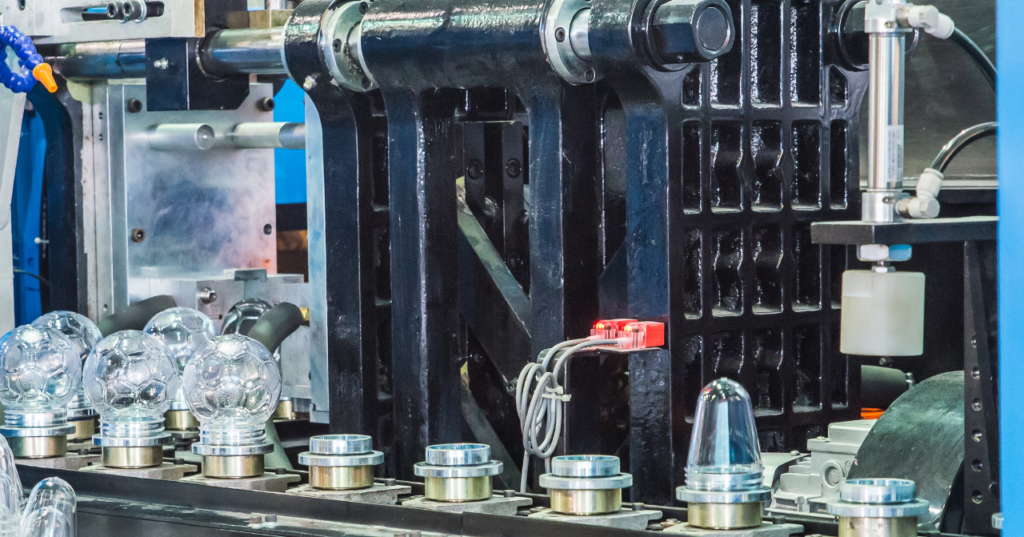
Selección del número de cavidades
The cavity number defines how many bottles are produced per cycle and directly impacts output capacity, machine footprint, and investment cost. Selection should align with production goals and bottle specifications.
- Single Cavity (1-cavity): Ideal for prototyping, low-volume production, or large-size bottles (e.g., 10–20 L). Offers flexibility and lower initial cost.
- Double to Four Cavity (2–4 cavities): Suitable for medium production volumes and small to medium bottles (0.2–2 L). Balances efficiency and machine size.
- Six to Twelve Cavity (6–12 cavities): Recommended for high-volume manufacturing of standard PET bottles (0.5–1.5 L). Maximizes output with efficient use of energy and floor space.
- Multi-Cavity Systems (16+ cavities): Used in large-scale production (e.g., water, carbonated soft drinks). Requires robust auxiliary systems and high automation.
Selection Tip: Match cavity count to required output (bottles/hour), mold availability, and factory layout. Higher cavities reduce unit cost but increase maintenance complexity.
Volumen de la botella
Blow molding machines are typically optimized for specific size ranges. Confirm compatibility with your target bottle volumes.
- Small Volume (50 mL – 500 mL): Common for water, juice shots, and pharmaceuticals. Requires precise control to maintain wall thickness.
- Medium Volume (500 mL – 2 L): Standard for beverages and liquid food. Most machines are optimized for this range.
- Large Volume (2 L – 10 L+): Includes jugs and containers. Requires higher-strength molds and robust stretch rod mechanisms. Machines may need slower cycle times.
Nota: A machine’s volume range is constrained by preform size, mold design, and stretch blow capability. Always verify machine specifications with the manufacturer.
Compatibilidad de preformas
The machine must accommodate the preform’s dimensions, weight, and material type to ensure proper heating and blowing.
- Acabado de cuello preformado: Must match the mold and handling system (e.g., 28mm PCO, 38mm, 1881). Verify compatibility with the machine’s neck gripping mechanism.
- Preform Length and Diameter: Check machine heater oven dimensions and loading system (linear vs. rotary). Mismatched preforms can cause heating defects or jamming.
- Tipo de material: Most machines handle PET; verify if compatibility extends to PETG, PP, or recycled PET (rPET). Some materials require adjusted heating profiles.
- Gama de pesos de preformas: Machines are rated for specific preform weights (e.g., 15–60 g). Operating outside this range affects heating efficiency and bottle quality.
Buenas prácticas: Use preforms from qualified suppliers and conduct trials to validate compatibility.
Equipos auxiliares: Compresor y enfriador
Reliable auxiliary systems are critical for stable blow molding operations.
Compresor de aire
Provides high-pressure air (25–40 bar) for bottle blowing.
- Capacidad: Size compressor to deliver continuous air at required pressure. General rule: 0.4–0.6 Nm³/min per cavity at 30–35 bar.
- Calidad del aire: Use oil-free compressors with dryers and filters to prevent contamination. Dew point should be ≤ –20°C.
- Almacenamiento: Include a receiver tank (10–20% of total demand) to buffer peak demands and stabilize pressure.
Enfriador
Cools molds to maintain cycle time and bottle dimensional stability.
- Capacidad de refrigeración: Typically 1–3 kW per cavity, depending on cycle speed and bottle size.
- Control de la temperatura: Maintain mold temperature between 10–15°C for PET. Precision control prevents stress whitening and improves clarity.
- Caudal: Ensure adequate coolant flow (e.g., 20–40 L/min per mold) with closed-loop circulation. Use corrosion-resistant coolant.
Consejo de integración: Match compressor and chiller specs to machine requirements. Undersized auxiliaries lead to cycle delays and quality issues.
In conclusion, sourcing blow molding machines for bottle production from China offers a compelling combination of cost-efficiency, advanced technology, and scalable manufacturing solutions. However, to ensure long-term success and operational reliability, two critical factors must be prioritized: Factory Acceptance Testing (FAT) and comprehensive spare parts support. Conducting a thorough FAT at the supplier’s facility allows buyers to verify machine performance, quality standards, and compliance with technical specifications before shipment, minimizing risks of post-installation issues and costly delays. Equally important is establishing a reliable spare parts supply chain—ensuring timely access to critical components reduces downtime and supports continuous production. By choosing reputable Chinese manufacturers that provide transparent FAT procedures and robust spare parts availability, buyers can maximize uptime, enhance productivity, and achieve a strong return on investment. Ultimately, a strategic sourcing approach focused on these key elements ensures not only competitive pricing but also long-term operational stability and success.






